AI Equity Research. Nine Agents. One Research Note.
Nine AI agents research, debate, fact-check, and synthesize — delivering a structured equity research note with independent verification and a human in the loop at every critical stage.
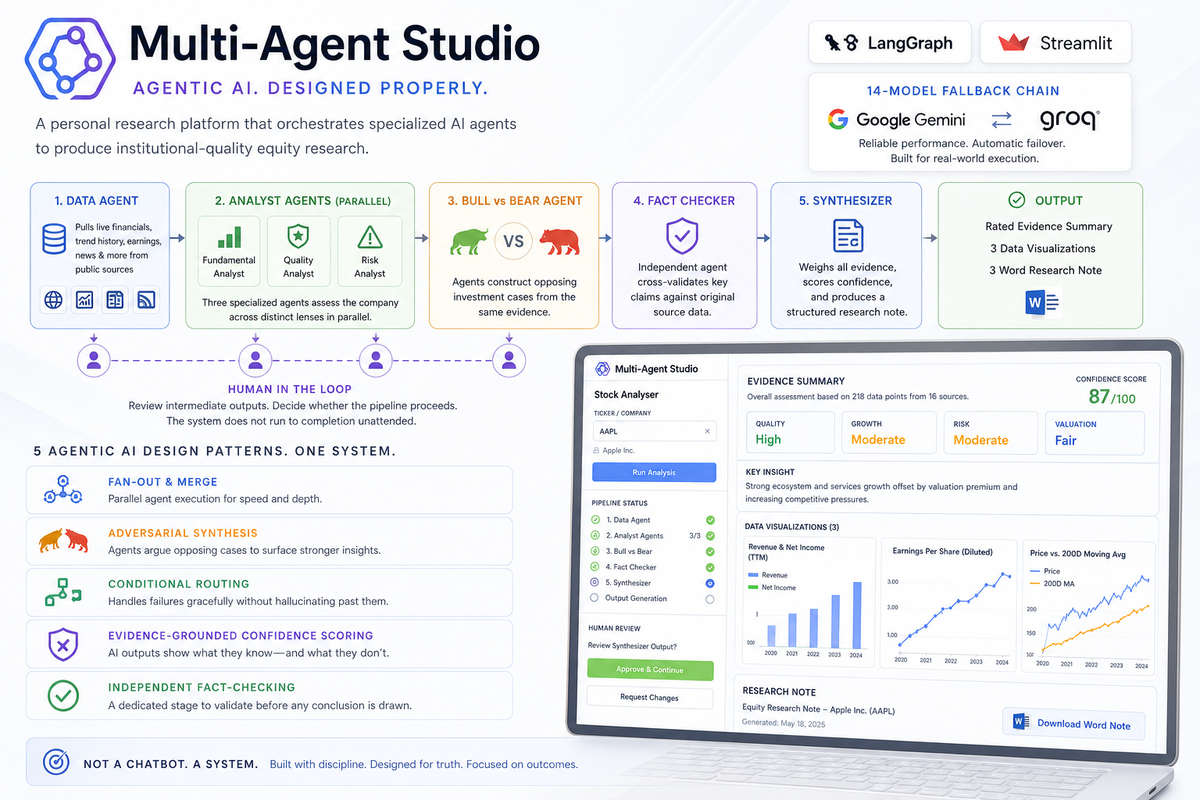
The Stock Analyzer module is part of the multi-agent platform and takes a single ticker or company name and orchestrates NINE specialized AI agents in a structured pipeline: a data agent pulls live financials, trend history, earnings records, and recent news from public sources; three analyst agents work in parallel to assess fundamentals, business quality, and risk; a Bull and Bear agent argue opposing investment cases from the same evidence; an independent Fact Checker agent then cross-validates key claims against the original source data before any conclusion is drawn; and a Synthesizer weighs everything to produce a structured equity research note modelled on sell-side analyst output. Every agent has a defined role, defined input, and a defined output. Every prompt sent to the AI is inspectable. At key stages, a human reviews intermediate outputs and decides whether the pipeline proceeds — the system does not run to completion unattended.
The platform is built on LangGraph, the leading framework for multi-agent orchestration, and demonstrates five agentic AI design patterns in a single working application: fan-out and merge for parallel agent execution, adversarial synthesis where agents argue opposing cases, conditional routing that handles failures without hallucinating past them, evidence-grounded confidence scoring that keeps AI outputs honest about what they actually know, and independent fact-checking as a dedicated pipeline stage rather than an afterthought. This is what multi-agent AI architecture looks like when it is built with discipline rather than demos. The output is a rated evidence summary, three data visualizations, and a Word-formatted research note.